


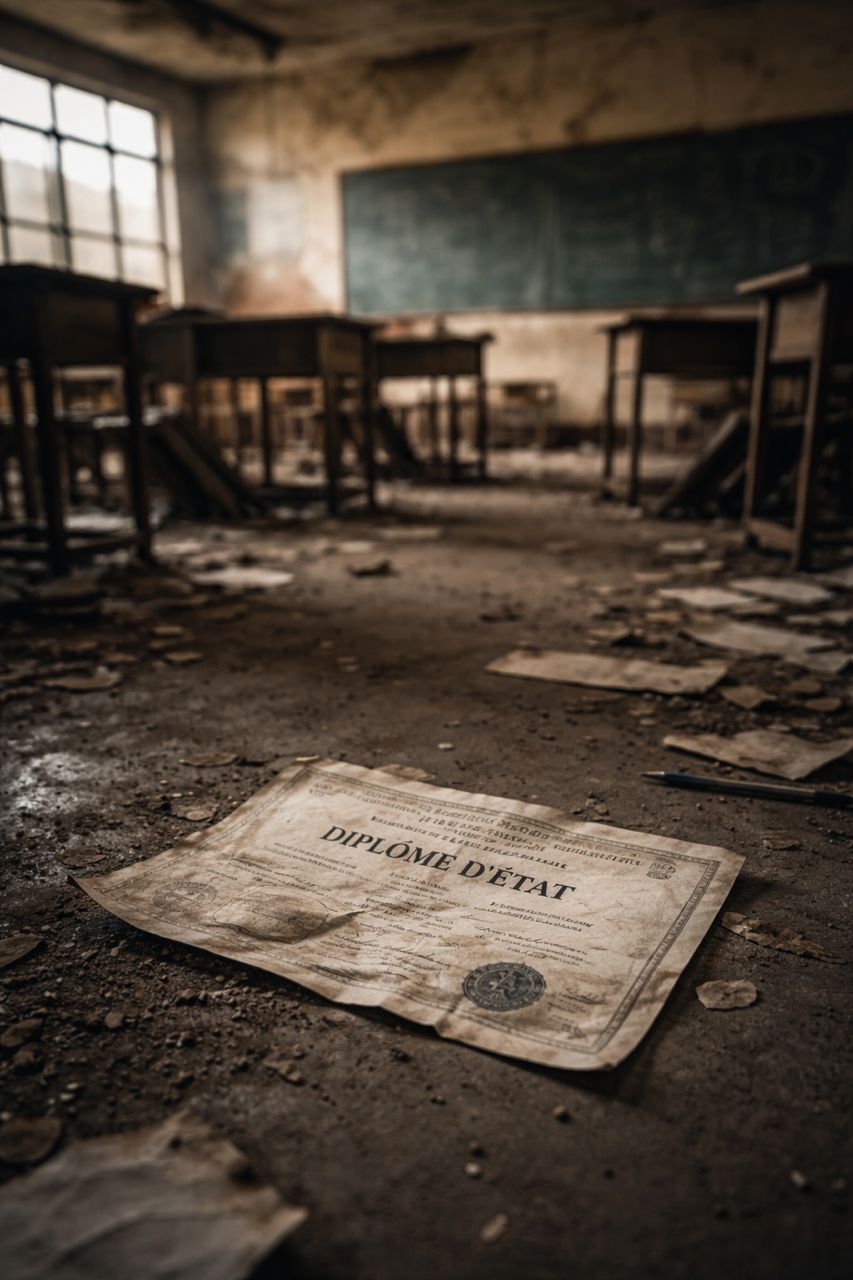
Education has always been the backbone of any strong nation. It shapes minds, builds character, and prepares future leaders. But what happens when this very foundation begins to collapse?
In the Democratic Republic of Congo, the situation is becoming increasingly alarming.
A System Losing Credibility
It is difficult to ignore the growing concerns surrounding the EXETAT (state examination). Even today, results are being published under conditions that raise serious questions. In some cases, students reportedly obtain two secondary school diplomas within the same year. Such irregularities inevitably damage the credibility of the entire education system.
Education, which should be based on merit and hard work, now appears, in some situations, to be influenced by financial power. There is a widespread perception that with enough money, it is possible to obtain an official diploma, particularly from Kinshasa. Whether fully accurate or not, this belief alone is enough to erode trust in national institutions.
A dangerous shift seems to be taking place—one where financial means overshadow academic effort. If diplomas can be bought rather than earned, then their value becomes meaningless.
This trend does not only affect individual students; it threatens the competence of an entire generation. A nation cannot progress if its graduates are not adequately prepared to face real-world challenges.
Discipline vs. Uncontrolled Freedom
Another concern lies in the evolving philosophy of education. There is an increasing tendency to grant students excessive freedom without adequate structure or accountability.
However, previous generations succeeded largely because they were guided by discipline. They studied under stricter conditions, with limited distractions and clear expectations. This environment, though demanding, helped shape resilient and capable individuals.
Freedom in education is important—but without balance, it can quickly become a barrier to success rather than a path toward it.
A Divided System?
Recent discussions suggest that the education system may be drifting into two distinct paths. One strives to preserve standards and academic rigor. The other, however, is perceived as offering an easier route—one that prioritizes access to diplomas over genuine learning.
In this second pathway, students who fail national examinations may find alternative means to obtain qualifications with minimal effort. Even individuals who previously dropped out before completing secondary school are said to have opportunities to acquire certificates through financial means.
If true, this parallel system risks institutionalizing mediocrity.
The Fall of a Once-Respected Diploma
There was a time when the Diplôme d’État stood as a symbol of excellence and perseverance. It was not easily obtained. The final year of secondary school was often referred to as “the border”—a defining moment. Crossing it meant that a student had reached a level of intellectual and personal maturity worthy of respect.
Today, that image is fading.
Diplomas are increasingly seen as ordinary documents rather than proof of competence. In some cases, holders of these qualifications struggle to demonstrate the knowledge they are expected to possess. This shift not only devalues education but also weakens confidence in those who hold such credentials.
There is a well-known idea: if you want to weaken a nation, undermine its education system. When standards fall, when merit is replaced by money, and when discipline gives way to disorder, the consequences extend far beyond classrooms.
The future of any country depends on the quality of its education.
Congo stands at a critical crossroads. The choices made today will determine whether education remains a tool for national development—or becomes a symbol of decline.
This article is not written to condemn, but to awaken awareness. Because once education loses its value, rebuilding it becomes one of the hardest challenges a nation can face.
Truly speaking your idea is good about that situation here in the democratic republic of congo.