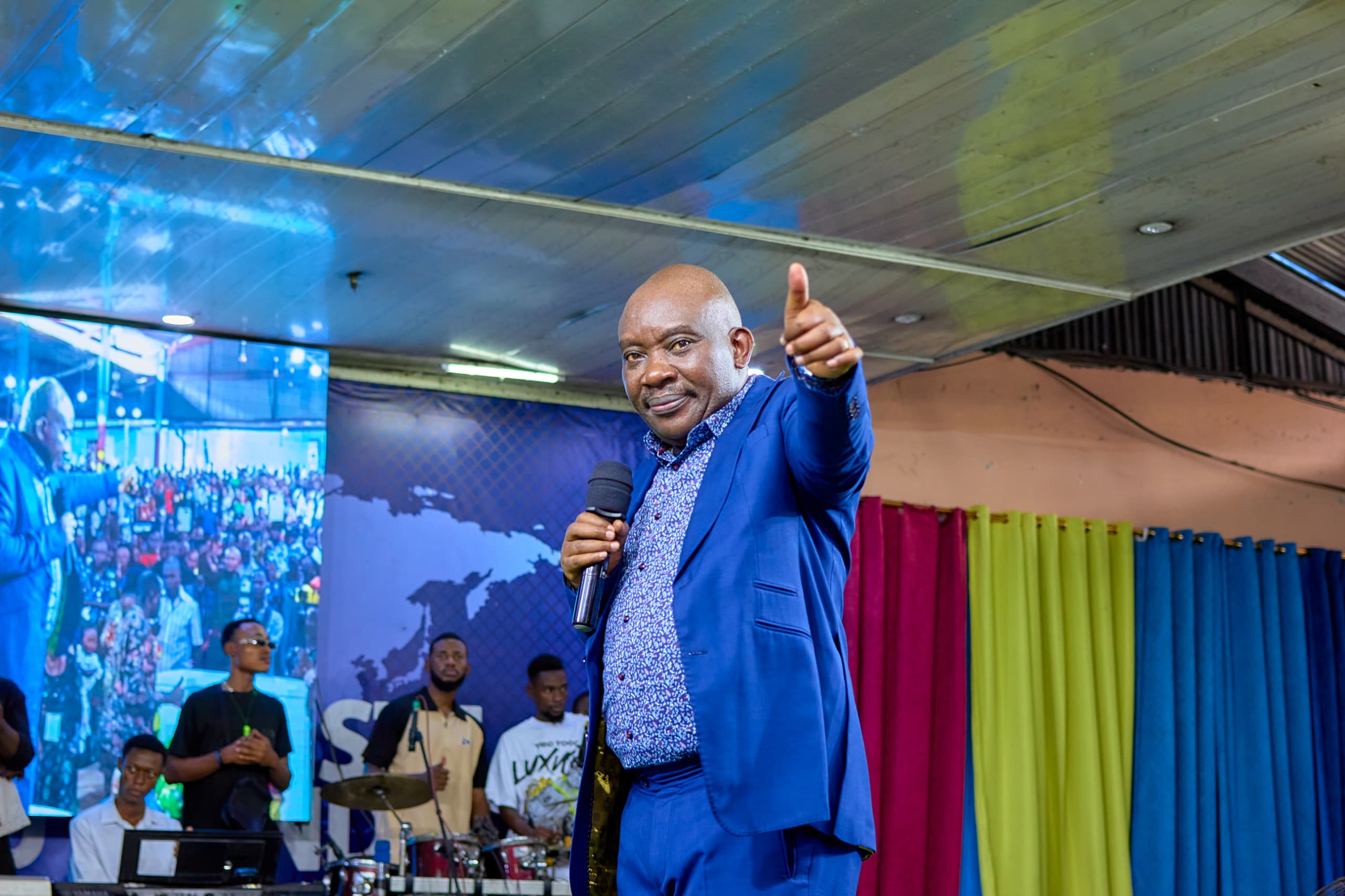



A controversial statement attributed to Dr. Prophet Mulindwa Jules, leader of City of Refuge Church, has continued to generate debate within Christian circles in the Democratic Republic of Congo.
In a recent interview on the phone, Pascal Buzima, a nation builder and political scientist, said the strong reactions directed at Mulindwa Jules were to be expected, arguing that questioning deeply established religious beliefs can provoke intense opposition.
A few weeks ago, a short video featuring Dr. Prophet Mulindwa Jules circulated widely on social media. In the video, Mulindwa Jules was heard referring to Jesus of Nazareth as “an idiot stuck on the cross in different cathedrals”.
The statement generated strong reactions among members of the Christian community, with several religious leaders condemning what they described as an insult to Jesus Christ.
Religious leaders associated with revival churches, together with the ECC (Église du Christ au Congo), issued a public statement condemning Mulindwa Jules’ remarks.
The statement emphasized that the Democratic Republic of Congo is a secular state with a predominantly Christian population and stressed the importance of respect for Jesus Christ within the Christian faith.
“We do remind that; DRC is a laic state predominated by Christians on a scale of 80%. The Christian faith is anchored in the respect of the person Jesus Christ and due honors to our fathers in faith.”
The religious leaders went on to condemn what they described as statements made against Jesus Christ by Jules Mulindwa, who, according to the statement, had referred to Jesus as “an idiot.”
Mulindwa Jules responds
Following the controversy, Dr. Prophet Mulindwa Jules responded to the criticism.
He argued that a real God is capable of defending himself and does not need human beings to defend him. He also warned his audience against drawing conclusions from short videos circulating on social media.
According to Mulindwa Jules, short clips can sometimes be taken out of context or manipulated in ways that influence the audience’s perception of what was actually said. He therefore encouraged his followers to seek out and watch the full sermon whenever they encounter a short video containing statements that appear unclear or controversial.
Pascal Buzima: “Harsh reactions were to be expected”
Speaking in an interview with NURU RTV journalist and City of Refuge Church apostle Naweza Emmanuel on September 29, 2026, Pascal Buzima offered his perspective on the controversy.
For Buzima, the strong reactions were understandable given the historical and cultural place that the name of Jesus of Nazareth occupies within Christianity.
He argued that Christianity has developed an established system of beliefs over centuries and that challenging some of those beliefs can consequently be perceived as a threat.
“The name Jesus of Nazareth is the only name humanity had heard since the beginning of Christianity. So, whoever brings something different or questions that name is automatically considered as a fool.”
Buzima compared the current controversy to the opposition Jesus Christ himself reportedly faced during his ministry.
“As an analyst, I totally understand because even when Christ tried to teach something a bit different from what scribes and Pharisees were teaching, they immediately labeled him as a madman. Others accused him of working with demonic powers.”
Based on this reasoning, Buzima said the reactions from members of the Christian community could be considered normal given what they have traditionally been taught about Jesus Christ.
Pascal Buzima questions the impact of Christianity in Congo
Buzima also addressed the decision by several religious leaders to unite in condemning Mulindwa Jules.
He described it as unfortunate to see religious leaders emphasizing that approximately 80 percent of Congolese people are Christians while, in his view, the country continues to experience poverty, conflict and recurring suffering despite its considerable natural resources.
“I myself have been taught the goodness of Jesus of Nazareth—that he is loving, marvelous, generous, healer…” Buzima said.
He then questioned what he sees as a contradiction between the widespread identification with Christianity and the realities experienced by many Congolese people.
“In their saying, 80% of Congolese are Christians. Now how come, paradoxically, all that 80% is living a terrible life?”
“They worship the same Jesus of Nazareth”
Buzima further connected the religious debate to the ongoing conflict in the Democratic Republic of Congo.
He argued that many of the people involved on opposing sides of the country’s political and armed conflicts identify as Christians.
“Another simple example is about the current situation in our country,” he said. “Rebels who are killing day and night and those who lead the country, they worship the same Jesus of Nazareth. Some of them even attend the same church.”
For Buzima, this raises a fundamental question about the relationship between Christian belief and the country’s continuing conflicts.
“How would you explain that the children of the same father keep killing each other?”
He argued that it is difficult to reconcile the professed belief in Jesus Christ as a powerful and reconciling figure with the continued violence between people who identify with the same faith.
Towards the end of his analysis, Buzima called on Christians to examine what they believe and whether they genuinely understand the faith they profess.
Buzima acknowledged that his language could sound harsh and asked his audience to bear with him.
He argued that, in his view, remaining within Christianity while continuing to participate in or tolerate the kinds of behavior he described would amount to “foolishness and imbecility.”
He further questioned whether some believers truly know the God they claim to worship.
“I think that they adore an unknown god who doesn’t exist or, worse, they believe in what they don’t really know, because people who believe in a powerful God cannot behave the way they do.” Buzima concluded by returning to the issue of reconciliation.
“If Jesus of Nazareth they are trying to defend were powerful, he would reconcile them for the sake of the country’s peace.”
In his final remarks, Buzima Pascal suggested that Dr. Prophet Mulindwa Jules’ message and vision may not be easily understood by everyone.
According to him, only people who are genuinely guided by the Holy Spirit and who have been chosen by God can fully understand and accompany what he described as Mulindwa Jules’ “revolutionary vision.”
His comments come amid an ongoing public debate over Mulindwa Jules’ statements about Jesus of Nazareth, the role of Christianity in Congolese society, and the relationship between religious belief and the country’s continuing social and political challenges. The controversy has consequently moved beyond the original statement itself, raising broader questions about religious interpretation, Christian identity and the role of faith in the Democratic Republic of Congo.